


/file/publisher-c1a3f893382d2b2f8a9aa22a654d9c97/2025/10/f29ad90c788e4cf1e9b2c927ea06b512.jpg)

Activists urge MACC to probe M'sian role in Papua New Guinea forest loss
Environmental NGO RimbaWatch has urged the MACC to investigate the conduct of Malaysian companies involved in the allegedly non-sustainable logging of Papua New Guinea’s rainforests.
Addressing a press conference today, RimbaWatch director Adam Farhan pointed to the recent publication of a report on the alleged role of Malaysian companies and individuals in the clearing of Papua New Guinea’s forests via Forest Clearing Authority (FCA) licences.
Environmental NGO RimbaWatch has urged the MACC to investigate the conduct of Malaysian companies involved in the allegedly non-sustainable logging of Papua New Guinea’s rainforests.
Addressing a press conference today, RimbaWatch director Adam Farhan pointed to the recent publication of a report on the alleged role of Malaysian companies and individuals in the clearing of Papua New Guinea’s forests via Forest Clearing Authority (FCA) licences.
Under the FCA licensing system, which is said to be a “major driver of deforestation and human rights violations” in Papua New Guinea, companies are permitted to clear vast tracts of forest land under the pretext of agricultural development.
However, due to how involved companies often fail to follow through with promised projects, the report claims logging firms - including several allegedly linked to Malaysian interests - have profited from large-scale timber extraction while leaving behind degraded land and displaced indigenous communities.
It also casts doubts on the legality of FCAs, alleging that the system has failed to bring about claimed development while promoting deforestation, poor transparency, and the violation of customary lands without landowners’ free, prior, and informed consent.
“From our perspective as a Malaysian organisation, we know that the FCA is at very high risk of certain types of violations, (including those relating to) environmental and financial laws.
“We would like to see the MACC conduct an investigation under the Mutual Assistance in Criminal Matters Act 2002 (as part of) joint probes with Papua New Guinea authorities,” Adam (above, centre) said.
Also present at the press conference today were Papua New Guinea Environmental Alliance (PNGEA) coordinator Pamela Abusi, Bruno Manser Fonds deputy director Johanna Michel, Komeok Joe with the Indigenous Peoples’ Organisation Keruan, Sarawak, and Papua New Guinean land rights activist Samuel Kime.
56-page report
The 56-page report, titled “Malaysia's Timber Colony: Exposing Malaysia’s Grip Over Papua New Guinea’s Forests,” was co-published by RimbaWatch, the Bruno Manser Fonds, and the PNGEA.
As part of its demands, the report also called for the MACC to assess whether Malaysian companies had obtained concessions through illegal methods, and determine if the firms had adhered to local and overseas laws.
It also pressed the graft watchdog to ascertain whether the companies were involved in any evasion of Malaysian tax and anti-money laundering regulations, including the Anti-Money Laundering, Anti-Terrorism Financing, and Proceeds of Unlawful Activities Act 2001.
“The government of Malaysia needs to immediately spearhead anti-Slapp (Strategic Lawsuit Against Public Participation) legislation to protect indigenous defenders, NGOs and activists from corporate intimidation and silencing,” it added.
At-risk tropical rainforest
Papua New Guinea, known as one of the world’s most vital biodiversity hotspots, forms the world’s third-largest tropical rainforest covering approximately 28.2 million hectares.
The area, however, is feared to be at risk as the report details that at least 1.68 million hectares of rainforest - an area equal to the size of Eswatini and Sarawak’s oil palm landbank - are under threat from FCA licences.
Despite a 12-month moratorium on new FCA approvals announced by the Papua New Guinea Forest Authority in 2023, the report noted that the measure had little impact, with timber export volumes staying nearly unchanged at 2.54 million cubic metres in 2023.
An overwhelming majority of FCA licences are also supposedly controlled by Malaysian-linked companies.
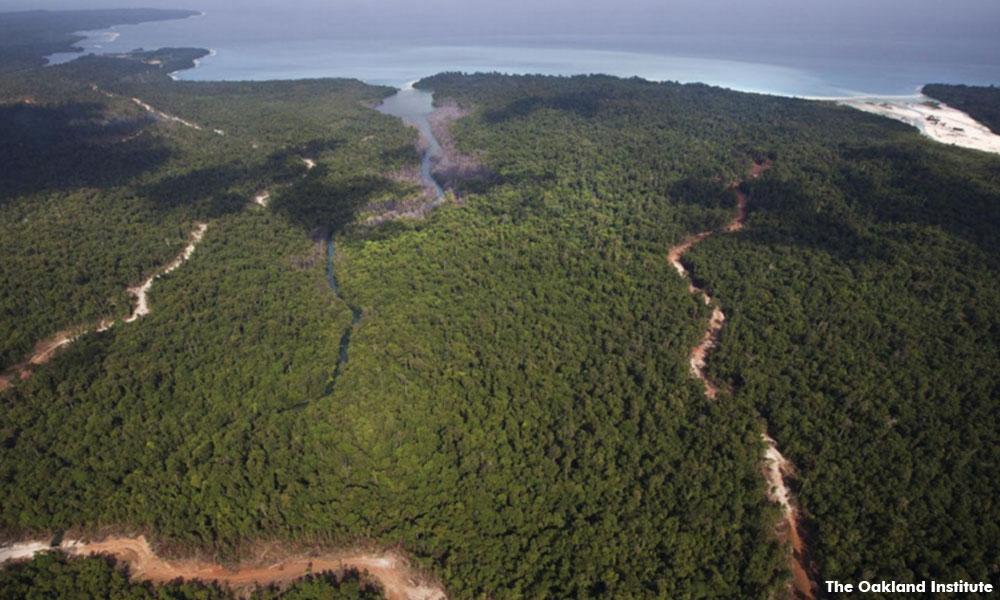
Out of 67 FCA licences, the report found that only two do not feature Malaysian links, leaving Malaysians accountable for 97 percent of total FCA licences.
The report alleged that some of the 79 Malaysian-linked individuals identified have faced allegations of illegal logging, fraud, and other misconduct.
It also claimed that some of the Malaysians implicated are connected to “politically influential families,” major logging companies, and were named in the Panama Papers expose in 2016.
“Starting their logging activities in Papua New Guinea more than 30 years ago, Malaysian-linked companies turned the country into the world's largest exporter of tropical roundwood within a very short time.
“Since 2013, Papua New Guinea has been the world's largest exporter of tropical timber, overtaking Malaysia, which had been the largest exporter for 30 years until only 10 percent of its primary forests remained,” the report stated.
Malaysiakini is in the midst of contacting the firms named in the report for their comments.
/file/publisher-c1a3f893382d2b2f8a9aa22a654d9c97/2024/06/f7a75c303be07d41b3d095c0f1fe10bf.jpg)
/file/publisher-c1a3f893382d2b2f8a9aa22a654d9c97/2024/06/f46a67ea90ffc2cc784a3c6de9bcd755.jpg)
/file/publisher-c1a3f893382d2b2f8a9aa22a654d9c97/2023/08/d4709c8b8a5c96eac44c9bec4e9273c4.jpg)
/file/publisher-c1a3f893382d2b2f8a9aa22a654d9c97/2025/05/53038d3a76b287344e899b5e0c5ea777.jpg)
/file/publisher-c1a3f893382d2b2f8a9aa22a654d9c97/2025/05/48d56ce92191255c6368693f6b03ec46.jpg)


Are you sure you want to delete this comment?
This action cannot be undone.